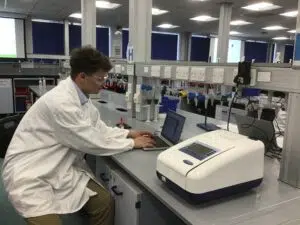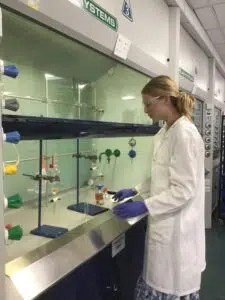


Our Lower Sixth chemists stepped into the world of university science last week as they visited the University of Exeter to complete a first-year undergraduate practical in its teaching laboratories.
The visit gave pupils the opportunity to experience university-level chemistry in a professional laboratory setting while developing practical skills that build on their A Level Chemistry studies. Working alongside university facilities and equipment also gave students a valuable insight into what studying chemistry at degree level could be like, helping to bridge the gap between school and higher education.
Exploring solvent extraction in the laboratory
During the session, pupils investigated the solvent extraction of methyl red and compared the solubility of methyl red and copper sulfate in three different solvents: water, ethanol and pentanol.
The practical introduced students to techniques commonly used by undergraduate chemists, encouraging them to think critically about how different substances behave in different environments. As well as reinforcing classroom learning, the investigation challenged pupils to apply their theoretical knowledge in a practical setting, developing the analytical and problem-solving skills that are essential for scientific study.
Working in a university laboratory also allowed pupils to experience the precision and attention to detail required in experimental chemistry, from preparing solutions to carefully recording observations and interpreting results.
Using UV-visible spectroscopy to analyse results
After completing the experiments, pupils analysed their findings using UV-visible spectroscopy, an analytical technique widely used in chemistry to identify and measure substances in solution. The results showed that methyl red was soluble in all three solvents, with the greatest solubility in pentanol. In contrast, copper ions were soluble only in water and ethanol.
While the science behind the investigation was complex, the outcomes were strikingly visual. The experiments produced vivid separations of immiscible red and blue solutions, giving pupils a clear demonstration of how different substances interact with different solvents and bringing the underlying chemical principles to life.
Inspiring future scientists
Visits like this form an important part of our commitment to providing enriching learning opportunities beyond the classroom. By working in undergraduate laboratories and using specialist analytical equipment, pupils gain confidence, deepen their understanding of scientific concepts and experience first-hand what university study can be like.
For many of our Lower Sixth students, the visit also provided a valuable opportunity to explore potential future pathways in chemistry, medicine, engineering and other STEM subjects. Experiences such as these help to nurture curiosity, encourage independent thinking and inspire the next generation of scientists.
We are grateful to the University of Exeter for welcoming our Lower Sixth chemists and providing such an engaging, challenging and inspiring practical experience.