

A disease is the “harmful deviation from the healthy structural or functional state of an organism” (Burrows and Scarpelli, 2024). Ageing can be described as the gradual accumulation of changes within an organism (Harman, 1981). These changes may be either beneficial or harmful to the organism. This essay will explore whether ageing meets the definition of “disease” by considering both its harmful and potentially beneficial biological effects. It will argue that ageing itself is more accurately interpreted as a normal, natural and necessary biological process rather than a disease. However, some processes that are associated with ageing can become detrimental and may be targeted for symptom relief or treatment if they become pathological.
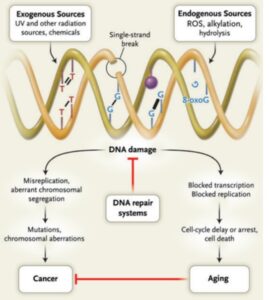 FIGURE 1: SOURCES AND CONSEQUENCES OF DNA DAMAGE (HOEIJIMAKERS, 2009).
If an organism ages without complications, its structure gradually deteriorates over time. In humans, cells progressively accumulate genomic instability and telomeres shorten due to exogenous and endogenous pressure, as depicted in Figure 1. Examples of exogenous pressure that cause these changes include ultraviolet radiation and carcinogens. Endogenous pressures include deoxyribonucleic acid (DNA) replication errors, reactive oxygen species from metabolism and depurination (Hoeijmakers, 2009).
These pressures may induce a DNA damage response (DDR), activating the p53-p21-Rb signalling pathway and leading to cellular senescence (Chen, Hales, and Ozanne, 2007; Harman, 1981). The DDR is a tumour suppressing mechanism, preventing tumours and cancers from forming. This is therefore beneficial to the organism’s survival. Senescent cells then produce chemicals due to their high metabolic activity, developing a senescence-associated secretory phenotype (SASP). Although SASP is beneficial in low levels as it promotes wound healing (Demaria et al., 2014), the accumulation of SASP causes inflammation and damage to tissue architecture (Tchkonia et al., 2013) This occurs due to the reduced efficacy of senescent cell clearance because of immunosenescence, a process that also progresses with age (Goyani, Christodoulou and Vassiliou, 2024). The detrimental effects of SASP and immunosenescence worsen as the organism ages, meaning that ageing may be seen as harmful to the organism. Ageing can thus be considered a disease in this light.
However, biological change may not always be harmful. Significant changes occur from the beginning of the human life cycle. During mitotic cleavage in embryogenesis, the zygote rapidly divides into blastomeres, forming the morula and later the blastocyst before developing into the embryo (Khan and Ackerman, 2023). Within approximately two weeks after fertilisation, the conceptus has already undergone considerable structural development. These processes demonstrate how biological change is necessary for human development. Additionally, the division of cells for adults as well as during embryogenesis is required for the replacement of senescent cells (Britannica, 1998). Cell division contributes to cumulative biological change over time, which forms part of the ageing process. Biological change is also required for reproduction, which is fundamental to the continuation and propagation of the human population. This becomes functionally active during puberty, where the hypothalamus begins pulsatile secretion of gonadotropin-releasing hormone (GnRH), which then stimulates gamete production (Heffner and Schust, 2010; Conn et al., 2013).
Accordingly, it can be argued that without ageing of the human body, reproduction and thus population survival would not be possible. Ageing in humans can therefore be considered beneficial for survival, only becoming detrimental and inflicting damage similar to a disease when there is excessive accumulation of cellular senescence following reduced efficacy of senescent cell clearance. Senescence, however, is experienced differently in organisms other than humans.
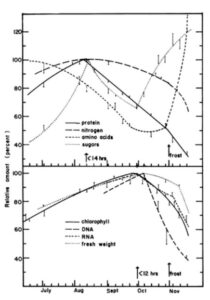 FIGURE 2: RELATIVE CHANGES OF APPLE LEAF CONSTITUENTS DURING SENESCENCE, DEMONSTRATING NUTRIENT RECYCLING (SPENCER AND TITUS, 1972).
Polycarpic plants, for instance, exhibit indeterminate growth, meaning their fruits or leaves may undergo senescence to facilitate nutrient recycling. (Guiboileau, Sormani, Meyer, et al., 2010). An example of a polycarpic plant is the Malus domestica, the common apple tree. It undergoes leaf senescence to recycle nitrogen content from the leaves into the tree’s reserves to support the regrowth of foliage and flowers in the following season, as illustrated in Figure 2. Leaf senescence transfers 40% to 80% of leaf nitrogen to the tree trunk and branches in the winter (Spencer and Titus, 1972). Thus, senescence should not always be considered a disease in plants as it may sometimes be beneficial. In this case, it provides efficient nutrient distribution that contributes to the formation of new, healthy organs.
Although leaf senescence involves cellular breakdown and may appear harmful at the level of individual leaves, it is a highly regulated, orderly and hormone-controlled process that benefits the organism; the short-term “damage” supports long-term nutrient redistribution and future growth (Guo and Gan, 2005; Volkava and Riha, 2024).
Ageing is necessary in the early development of life. Without the accumulation of change that ageing consists of, humans could not biologically mature. The detrimental element of ageing in mammals is the excessive accumulation of senescent products due to immunosenescence. However, senescence is too nonspecific to be defined as harmful to the organism, as many organisms may use senescence beneficially. Ageing involves benefits as well as detriments and thus cannot be narrowly defined solely as a disease.
Treatment refers to medical attention provided to an individual (Collins, 1991). Humans already use treatment to mitigate age-related physiological declines. For example, hearing aids treat the effects of presbycusis (Cheslock and De Jesus, 2023). Multivalent vaccines enhance immune responses against multiple pathogens (Goyani, Christodoulou and Vassiliou, 2024). The prescription of alpha-tocopherol, a form of vitamin E, helps manage oxidative stress (Singh, Devaraj, and Jialal, 2005). Doctors should strive to improve the condition of those who suffer while adhering to the principle of non-maleficence, as communicated in the Hippocratic Oath (Berdine, 2015).
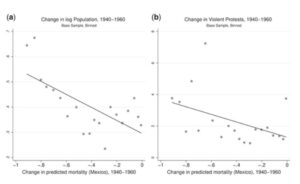 FIGURE 3: CORRELATION BETWEEN (A) PREDICTED MORTALITY TO LOGARITHM OF POPULATION AND (B) PREDICTED MORTALITY TO NUMBER OF VIOLENT PROTESTS IN MEXICO. (ACEMOGLU, FERGUSSON AND JOHNSON, 2019)
The principle of non-maleficence can be applied to challenge the dilemma of whether we should “cure” ageing, as removing age-related diseases may cause more harm than benefit. Age-related diseases such as type 2 diabetes mellitus and ischemic heart disease are responsible for nearly 70 percent of deaths in the United States of America and Europe (Fontana, 2010). This means curing ageing, assuming that ageing is a disease, may result in a proliferation of the global population. Overpopulation could result in a strain on housing stock, ultimately leading to homelessness, a shortage of finite natural resources and food, and increased social conflict (Winkleby and Davis, 1988). Acemoglu, Fergusson and Johnson (2019) executed a global study that demonstrated how countries with larger populations in the 1940s tended to experience more social conflict, a prominent example being Mexico, as demonstrated in Figure 3. Reduced mortality rates led to an increase in population, resulting in increased violent protests. This is linked to the Malthusian mechanism, which expresses how food availability does not grow fast enough to support population growth (Acemoglu, Fergusson and Johnson, 2019). This means people may become more aggressive when trying to secure the limited resources available, such as food, land or water. Homelessness and social conflict all contribute to an overall negative living environment, as they impact health and reduce the life expectancy of individuals in the population (Winkleby and Davis, 1988). Therefore, if ageing were to be “cured”, it may induce more harmful effects than benefits.
One can also explore the possible effects of curing ageing in humans by looking at an organism that does not undergo senescence when grown in ideal conditions. Hydra is a genus of freshwater polyps that do not age biologically as they have mechanisms to prevent senescence (Schenkelaars et al., 2020). In this way, they are considered biologically immortal. Unlike humans, Hydra exhibit high forkhead box O expression (FOXO) in relation to their total volume (Boehm et al., 2012). FOXO is a transcription factor that regulates genes involved in cell maintenance, stress resistance and stem cell renewal (Boehm et al., 2012). This activity limits the accumulation of terminally differentiated cells, preventing the build up of senescent cells. However, despite their biological immortality in laboratory conditions, Hydra have a short lifespan in the wild due to extrinsic pressures such a predation and environmental stress (Sahm et al., 2022). Therefore, if humans were to treat senescence and try to eliminate ageing, the outcome could be similar to that of Hydra in that extrinsic pressures may still result in mortality.
Accordingly, it can be argued that ageing should not be considered a disease. Ageing is a fundamental and necessary biological process, as it includes the accumulated changes experienced during foetal development as well as maturation during puberty. It is more accurate to argue that immunosenescence and the resultant excessive SASP secretion is what is the “disease” in ageing. Medical care should therefore be directed at treating the pathological elements of ageing and their symptoms, if troublesome to the person, instead of trying to “cure” ageing as a whole.
 C. Wallace, Lower Sixth