


You see here two remaining features from the St John’s Hospital buildings, which stood by the junction of the High Street and Paris Street. It housed the Free Grammar School (which was to become today’s Exeter School) and the Free English School (known as the Bluecoat School), which existed to educate deserving boys of limited means. The latter school took its name from the distinctive blue gowns worn by its pupils.
The doors are believed to come from the Grammar School, perhaps from the inner courtyard. The Grammar School was demolished following the school’s move to its present site, and at some point after that the doors came into the ownership of Walter John Pitts, owner of John Pitts & Sons Ltd, Trew’s Weir Paper Mills where they formed part of the end wall of the mill workshop. When the paper mill ceased production in 1983 the Pitts family generously donated the doors to Exeter School.
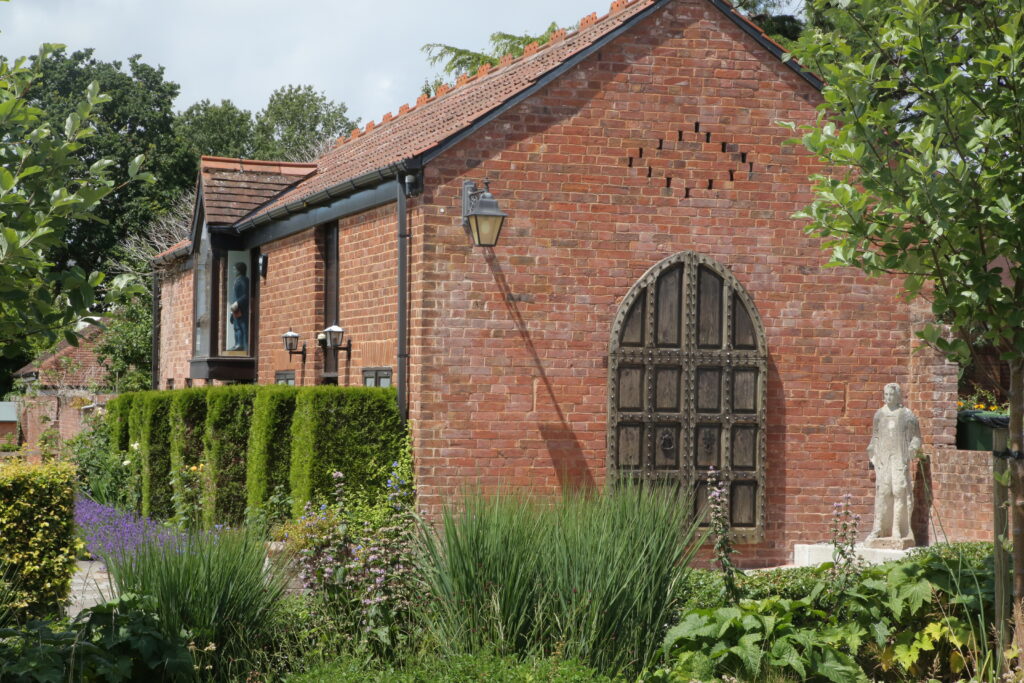
The statue of the charity scholar was commissioned by the Bluecoat School in 1733 from John Weston, a noted Exeter stone cutter of the time. He took as his model George Wall, whom he had taken on as an apprentice from the Bluecoat School and who had impressed by his character and abilities. The original statue, long lost but eventually found in a garden in Rosebarn Lane, stood in the courtyard of the Bluecoat School and was eventually, in 1869, replaced by a number of cast-iron figures. Today, one such figure keeps watch over Exeter School from the dormer window of the Archive Centre, another stands in the Maynard School grounds and the best-known copy stands at the top of Princesshay near a corner of the city wall, near to the spot where the original stone statue stood in the Bluecoat School courtyard in another age.
Exeter School is grateful to OE John Pitts (1969–1980) for supplying information concerning the doors donated by his family.