
Extended Project Qualification (EPQ)

Overview

The Pearson Edexcel Level 3 Extended Project allows pupils to study a topic area which extends their learning in an area of study, as a standalone qualification. Learners devise an analytical dissertation question which expands their learning in their field of study, in a related area, or in an area that is relevant to their own personal interests. The EPQ is offered as a dissertation and takes place in part through the Futures programme. Pupils are provided with some taught sessions to develop research and referencing skills, and to guide them on how to structure and complete the project successfully. Individual feedback meetings take place at pivotal points, although the essence of the programme is to provide an opportunity and framework for independent research and self-centred study.

Given the possibility of reducing their study programme during the Lower Sixth, pupils may choose to focus their three remaining subjects alongside an EPQ. This structure enables them to dedicate more time to in-depth study and research, consolidating their academic strengths while developing the independent learning and critical thinking skills that universities and employers value highly.

Those who complete this qualification find themselves very well-equipped for the demands of undergraduate study, having conducted their own academic research presented in a format that conforms to the conventions required in academia.

Course Outline  

The EQP is an optional, self-directed research project that pupils typically complete at sixth form. Highly regarded by universities, an EPQ demonstrates academic commitment that helps distinguish pupils and raise their educational profile. As a level 3 qualification (like A levels), UCAS points will be awarded alongside the achieved grade. Pupils will be assessed on their ability to plan, manage, complete, and review their project. It is completed between October in the Lower Sixth through to December in Upper Sixth. The project requires the submission of a project proposal form, project activity log, dissertation, and a 10-minute presentation to an audience.

Method of examination

The Extended Project Qualification is 100% coursework based. As a result, pupils are not required to sit an additional exam. Since the project is self-directed, pupils have the autonomy to choose their subject topic and manage their own time. The nature of the qualification encourages a strong ethos of independent learning and critical thinking, much like a university dissertation. 

It is assessed by supervisor-assessors from within Exeter School and externally moderated by the exam board. An EPQ is worth half an A Level. The final dissertation is typically between 5,000 and 6,000 words in length.

Can you fail an EPQ?

Yes, just like any other academic qualification, you can fail if you do not meet the correct criteria. Some common reasons pupils fail include not choosing a topic they are truly passionate about, bad time management, poor structuring, not meeting the recommended word count, plagiarism, or a weak argument. 

Entry Requirements 

None specified

Exam board and entry 

Pearson, Extended Project Level 3 P301

Next Steps 

An EPQ qualification can be used by some universities to adjust UCAS offers. For example, a UCAS offer of AAB could be adjusted to ABB with an A in an EPQ. Many universities, including highly selective ones, recognise the EPQ as an indication of super-curricular academic engagement beyond sixth form subject courses. Reference to an EPQ in a UCAS personal statement can provide a useful point of discussion (including at any interviews) and also improve prospects of degree outcomes.

Contact 

Mr L Chu, Assistant Head (Sixth Form)
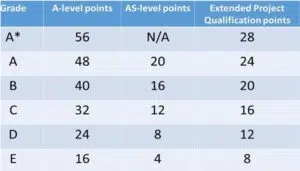
Can the EPQ be worth the same UCAS points as an AS level and do Universities value it?

  • It is a Level 3 (A Level standard) qualification
  • It is worth UCAS Points (equivalent to half an A Level) & you could get reduced offers including it (but not for all universities and courses)

Table of UK A-Level/AS-Level/EPQ points by grade: A*-56, A-48/20/24, B-40/16/20, C-32/12/16, D-24/8/12, E-16/4/8

Many universities value the Extended Project Qualification (EPQ) because it demonstrates a student’s ability to research independently, think critically, and manage a substantial project. Students can use their EPQ to strengthen their UCAS personal statement and discuss it during university interviews, giving them the opportunity to showcase their interests, skills, and motivation. As admissions tutors have noted, the EPQ can become the “heart” of a personal statement by adding depth and substance, while the research, analysis, and independent learning skills it develops provide excellent preparation for university-level study.

What does the EPQ involve?

You will be assigned to one of three EPQ supervisors.


The EPQ is part of the Futures programme and taught sessions will typically take place in these sessions once a fortnight. They may consist of:

– A whole-group session on a specific skill or aspect of the project

– Individual 5-minute check-ups

– Individual 15 minute ‘milestone’ reviews


  • To begin with, you will need to explore different topics and ideas for your EPQ before settling on an area of research and a draft title / question. This stage needs to be recorded and approved on a Project Proposal Form (PPF).
  • From the outset, you will need to maintain a reflective activity log, to record the progress of your project from the planning and research stage, right through to the final submission.
  • During the main research phase, you will need to keep a record of all the sources that you come across and research, and create a bibliography. Guidance and support will be offered on how to go about your research, but you will need to show initiative and determination in order to gather not only sources that are sufficient in number and quality, but that cover a range of different types.
  • The core element of your EPQ is a written dissertation. This is typically around 3,000 – 5,000 words, including all sections.
  • As part of the dissertation, you will need to showcase your sources and show that you have selected them carefully, analysed them objectively, synthesised the information they provide and assessed their credibility. This is usually in the form of a literature review.
  • The final element is your review of your Extended Project, for which you would typically write a short evaluation as well as making a presentation to a live audience.


Your way of working on your Extended Project will be different to anything that you have done before. It will require you to always stay on top of your own work and to plan and prepare for specific, long-term deadlines. You will have guidance sessions on specific skills and strategies, and you will of course be able to ask your supervisor for assistance at any time; but it is expected that you will manage and complete the vast majority of the work independently.

You may also find it useful to ask a relevant member of teaching staff to act as a ‘subject advisor’. This additional person may be able to help you with specialised, subject-specific aspects of your project such as the location of useful resources or any technical aspects that arise. You are strongly advised to also discuss your project with the librarians, for advice and support in finding sources.

The EPQ provides you with the opportunity to develop your knowledge and understanding of a selected topic. Typically, most of your research will be from secondary sources, but sometimes it can be appropriate and advantageous to collect and include some primary data (e.g.interviews).

What is the timeline?

Autumn Term Lower Sixth – Attend meetings in Tuesday Futures slots and carry out assignments as instructed. These will be based around building core skills and paving the way for research to begin in earnest.

Spring Term Lower Sixth– Gather core research and build a folder of resources (Complete Project Proposal Form; Milestone #1).

Summer Term Lower Sixth – Concentrate on end of year exams in your subjects and then ensure that everything is in place to write your draft EPQ dissertation.

Summer Holiday Lower Sixth – Write the first draft of your full dissertation.

Autumn Term Upper Sixth – Feedback on your draft discussion (Milestone #2). [Complete your UCAS application]. Produce the improved draft of your dissertation, including the abstract and evaluation.

Spring Term Upper Sixth – Final hand-in final of complete EPQ, and presentations.

How is it assessed?

This qualification is assessed by your supervisor, internally standardised, and externally moderated. Although the bulk of the marks will come from the final dissertation, over half of the marks will also be assigned based on your planning and management of the whole project, the handling of your sources, and your review process.

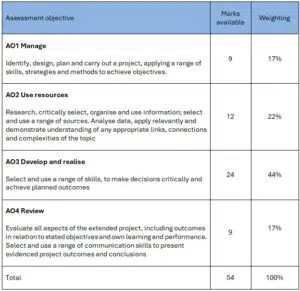
There are four assessment objectives for the Pearson Level 3 Extended Project (P301) that cover the knowledge, skills, and understanding that you are required to demonstrate. They are detailed below, along with their weightings:

Table of assessment objectives AO1–AO4 with marks and weightings (Total 54 marks, 100%). Shows objectives and brief descriptions for each objective in an exam rubric.

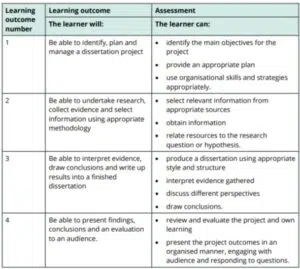
What should be the final outcomes of the project?

Your completed project MUST evidence all the above learning outcomes.

A typical project will be 5,000-6,000 words in length, including most core elements. You will not be penalised for producing work outside the suggested word count, but you should ensure your word count allows you to meet the assessment objectives. Note that the bibliography and any appendices do not count towards the final word count.

Hard copies of exemplar dissertations can be found in the Sixth Form Centre or in the Library.

Points to consider

  • Studying for an EPQ is not a taught course and doesn’t replace the benefit of learning from, and being challenged by, the extra subject choice in the L6. It is an option that you can choose to add to your timetabled studies
  • You need to be realistic about the range and types of challenges / opportunities that you want to make the most of in the L6. Engaging in an EPQ is great for all the reasons already discussed, but it doesn’t fit everyone! For each of the past three years, around 50-60 L6 pupils have started the EPQ process and between 20-30 have completed it
  • In addition to all the benefits, think also about the sacrifices that will be needed in order to complete the project (see next slide)
  • At Exeter School, we only offer the dissertation option within the Edexcel EPQ specification