


Vaccines have been used in humans in one form or another since 1776 when Edward Jenner inoculated 8-year-old James Phillips with cowpox matter providing immunity to smallpox (1). This first step by Jenner has led to millions of lives saved across the globe.
A vaccine works by stimulating the production of antibodies towards a specific pathogen through the activation of the body’s primary immune response. Multiple forms of vaccines exist today, all of which follow the same principle of introducing the body to a pathogen before they are encountered naturally, preventing the pathogen from causing harm.
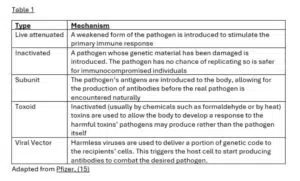
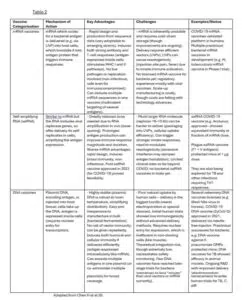
Table 1 summarises five common types of vaccines that have been created since Edward Jenner started his work. Each of these types are established vaccine technologies that have been used effectively to protect people. Nucleic-acid vaccines are a new variation based upon the existing principle of vaccines and look to improve upon the weaknesses of existing vaccine types such as slow development times and the limited effectiveness that certain types (subunit vaccines) have with only one dose. Nucleic-acid vaccines are an exciting new development in the world of inoculation and may very well be our best defence against future outbreaks, epidemics, and pandemics. This essay will seek to explore the pros and cons of nucleic acid vaccines and look to answer the question of whether nucleic acid vaccines could save humanity from the next global pandemic. Table 2 summarises the three types of nucleic acid vaccines, their mechanisms, and key advantages.
Messenger Ribonucleic-acid (mRNA) vaccines are the most well described and studied of the nucleic acid vaccines, and are the best known after the last global pandemic of 2020, Coronavirus-19. If we take the mRNA vaccines of the COVID pandemic as an example, we can explore the positives and negatives of these vaccines in greater detail.
mRNA vaccines were first proposed in the early 1970s, but it was not until the late 1990s that they were they confirmed as a viable option (2). The COVID-19 pandemic functioned as an accelerated trial period for mRNA vaccine technology, leading to rapid development and rollout of this type of vaccine, saving millions of lives. While COVID-19 vaccines currently remain the only approved mRNA vaccines, others are under development. Figure 1 explains how mRNA vaccines work in detail, showing the twelve steps the vaccine takes to produce the Major Histocompatibility Complex (MHC) class 2 molecules that the human body requires to mount an immune response to antigens.
The main advantage of mRNA vaccines is the efficiency and speed with which they can be mass produced, a 5L bioreactor can produce over a million doses of mRNA vaccine in one reaction (3) taking only 42hrs (4).This means that production of an mRNA vaccine is over ten times faster compared to conventional vaccine production technologies such as inactivated vaccines like the influenza vaccine. These vaccines are typically produced using embryonated eggs and take 6-8 months.
If an event occurs, such as a pandemic or epidemic, mRNA vaccines could be quickly and effectively produced in high volumes to bring about widespread immunisation programmes should the proper facilities be developed.
We saw this rapidity demonstrated during the COVID-19 pandemic. The average length of time it takes from conception to roll out for a vaccine is 10-15 years (5). In COVID, a prototype Self-Amplifying RNA (saRNA) vaccine was generated only 2 weeks after the isolation of the genetic sequence of the spike protein of the SARS-CoV-2 virus. The US company Moderna went from this information to human testing of an mRNA vaccine in only 42 days (3), highlighting the speed at which this vaccine was created and evaluated.
mRNA vaccines and saRNA vaccines may also have applications outside protection from viruses. Drug resistant bacteria are a huge problem within world health with 39 million deaths projected between 2025 and 2050 (6). mRNA vaccines are being actively explored for bacterial infections. These include difficult targets like Tuberculosis (TB) and Escherichia coli (E. coli), with the tuberculosis mRNA vaccine currently undergoing Phase I trials. Referring to figure 1 we know that mRNA vaccines work by giving your cells the genetic information with which to produce pathogenic antigens, before subsequently mounting an immune response against them. This method may be used for more complex bacteria such as TB, where strings of mRNA could be effectively utilised. (6).
While being comparatively easy to develop and mass produce, mRNA vaccines have key drawbacks. For instance, the mRNA COVID vaccines developed by Pfizer and Moderna have strict storage requirements: -70 C and -20 C, respectively. The Pfizer vaccine is more time pressured as it needs to be transported to the ultra-cold freezer within five minutes of arrival. Before administration, the vaccine must be thawed to either room temperature (used within 30 mins) or moved into a routine refrigerator and stored there for up to 5 days (7). Other types of vaccine such as viral vector vaccines do not need these temperatures restrictions, giving them a greater level of applicability in remote rural areas where ultra-cold freezers are less likely to be found. These strict transport requirements mean that mRNA vaccines are quite difficult to distribute globally, especially into areas with
less robust supply chains.
During COVID, African nations saw significant disruption to vaccine rollout due to difficulties both with transport and supply of vaccine doses. The World Health Organisation (WHO) office in Africa initially set a target for 60% inoculation, however in 2026 only 51% of the population has ever been vaccinated with 53 million doses not used (8). There has been significant vaccine hesitancy in certain areas of Africa, and indeed the globe, hindering a complete roll out of these vaccines.
To ensure smooth rollout and global vaccination in future, prior planning must take place to ensure that distribution routes, supply
chains, and formal agreements are already in place before the need for vaccination even occurs.
The cost of nucleic vaccines is also a significant detraction from the idealistic situation in which all people could be inoculated and protected from disease. During the COVID-19 pandemic Pfizer operated a dynamic pricing scheme, seemingly to boost profit margins, with prices per dose ranging from $6.75 (paid by the African Union) per dose up to as much as $28 (paid by Israel) which is almost twenty-four times the potential production cost (9). One dose of the vaccine cost the same as Uganda spent per citizen on health in an entire year. These excessive pricing schemes are one of the primary roadblocks preventing ideal
distribution.
Whilst the total cost of creating the Moderna COVID-19 vaccine is withheld from the public by the company, we do know the US government invested $18 billion dollars in six vaccine candidates via Operation Warp Speed (10). Of this, an estimated $6 billion went to Moderna. Despite this cost, nucleic acid vaccines have proven themselves able to be developed and rolled out quickly when required. This reflects positively on their abilities to be used successfully in future pandemics.
If a complex bacterium where to mutate and become virulent with a high mortality rate, would the vaccine production be as successful in this scenario as it was in COVID-19? The Ebola epidemic of 2018 in the Democratic Republic of Congo in West Africa had a mortality rate of 66% (11), which is significantly higher than the SARS-CoV-2 virus which peaked at a case fatality rate of 5.4% (12). Vaccinologists investigating vaccines for Ebola have found that rather than extensive roll out, a targeted vaccination protocol for contacts of infected humans can also be effective (13). This is known as “ring vaccination,” and in conjunction with strict containment was effective in stopping the Ebola epidemic of 2018. Therefore, a universal emergency vaccine programme may not be the most efficient method for all epidemics and more targeted and varied approaches could be taken.
In conclusion, nucleic acid vaccines have the potential to be highly beneficial in allowing humanity to survive future pathogen outbreaks. However, significant work must be implemented for that potential to be fully realised. During the COVID pandemic there was significant vaccine hesitancy, which drastically reduced the effectiveness of the global inoculation movement. For herd immunity to occur widespread education programmes discussing vaccines should be brought out alongside significant research into the root causes of vaccine hesitance so they may be addressed (23). For COVID, the structure of the virus was fortunate with the presence of an easily identifiable and stable spike protein. This allowed researchers to react quickly. For future outbreaks which may be significantly more deadly we must have already completed as much of the basics of research and planning. This
will allow us to have the necessary infrastructure already in place for distinct types of pathogens e.g. virus or bacteria, and the building blocks of a variety of vaccine types which could be built upon for a new pathogen. Efficient delivery models and pre agreed costs of vaccines and supplies chains must already be in place should a highly dangerous or virulent pathogen strain develop.
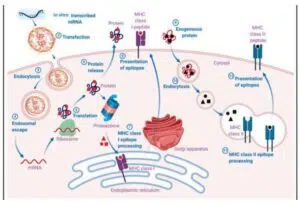
Pharmacological mechanism of adaptive immune responses induced by mRNA-LNP vaccines (2).
(1) In vitro transcribed mRNA is encapsulated into a lipid nanoparticle (LNP). (2) Transfection of mRNA-LNP vaccine molecules into the host cells, using specialized lipids on the surface of the LNPs. (3) Endocytosis of mRNA-LNP. (4) Endosomal escape of mRNA to the cytoplasm after endocytosis-related internalization. (5) Translation of the mRNA by the host cell ribosomes into the desired antigen protein intracellularly. (6) Antigenic protein released outside the cell, or the antigenic protein is degraded by a proteosome, exposing the antigenic sites. (7) Major Histocompatibility Complex I (MHC I) epitope presentation of the MHC I to the cell membrane for antigen presentation (APC). (8) MHC I presents the epitope to CD8+ T cells. (9) The exogenous protein released earlier can get degraded and presented via MHC II epitopes. The extracellular antigen can get recognized by B cells, leading to B cell maturation.
 A. Ludman, Lower Sixth